written by ChatGPT 5.1, prompted by me:
In the winter of 2043, the National Archives received a peculiar manuscript: Tratado sobre el Mercado, unsigned, bound in unmarked gray paper. The archivist who catalogued it (a taciturn man named Uribe, whose only known hobby was stamp collecting) initially mistook it for an economics thesis. Its opening pages described, with tedious precision, the mechanics of a global system of prediction markets. But deeper into the text—after a digression on liquidity curves—it wandered into stranger territory.
The anonymous author recounts the rise of the Oracle Network, a system in which every possible event was given a price, and every price was presumed to be the truest statement the world could offer. Elections, epidemics, the survival of long-forgotten languages—each had its corresponding probability, fluctuating like a pulse. Citizens spoke of themselves in percentages; the future became a vast ledger written in numbers that shimmered and updated endlessly.
The author claims (and swears, in an oddly emotional footnote, that this is not metaphor) that the markets ceased merely predicting outcomes and began summoning them. A mayor abandoned his campaign because his own probability dipped below fifteen percent. A software collective finished a long-stalled project after several of its members placed reckless bets in favor of its completion. Even the weather—long the domain of gods and satellites—seemed to obey its quoted odds with unnerving obedience.
Uribe, dutiful but curious, consulted two colleagues. One dismissed the manuscript as allegory. The other, a scholar of ancient religions, pointed out its resemblance to the Delphic rites: mortals gathered not around a priestess but around an algorithmic flame, interpreting fluctuations in place of cryptic verses.
The manuscript’s final chapter is the briefest, though Uribe later confessed it haunted him most. It tells of a theorist named Valera who proposed that the Oracle Network formed not a set of predictions but a map of all possible futures—a map that rewrote itself as people looked at it. Valera observed that whenever probability neared certainty, citizens behaved as though the event were inevitable, and by behaving thus, rendered it so. He offered an unsettling corollary: perhaps low-probability events failed to occur not because they were unlikely, but because no one believed in them sufficiently to bring them into being.
Valera’s last recorded speech (quoted in full) ends with a single line: “The future consults us before it arrives, but we are too enchanted by its numbers to answer honestly.”
——-
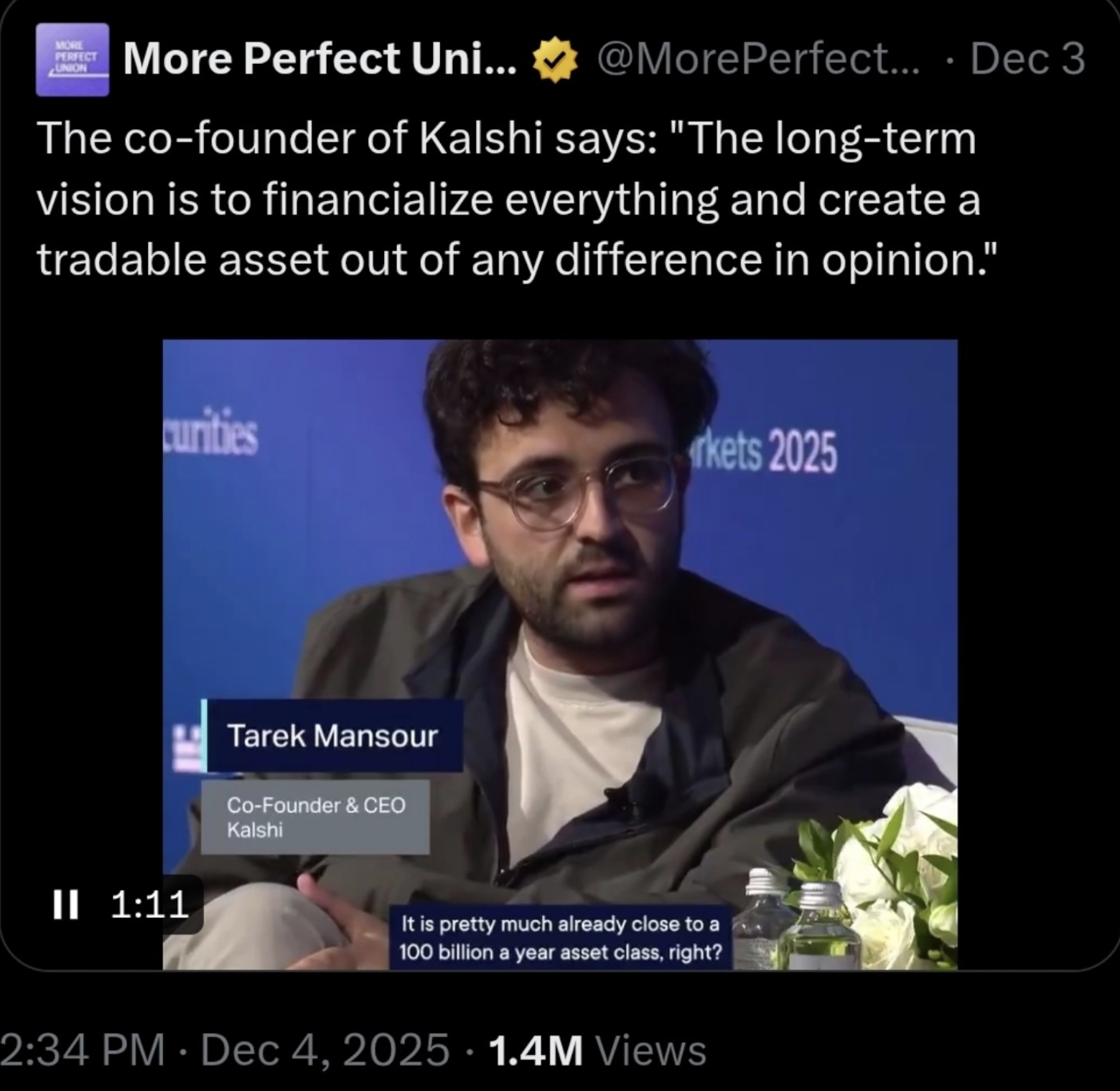
inspired by: